- Published on
A SAMPLING OF NEW WORKS: RISING WITH MATERIALS FROM THE SEA
- Author
-
-
- Name
- Posts
- Posts
-

(To the tune of Patsy Cline’s “I fall to pieces…”) “I comb the beaches…”
Living by the Gulf of Mexico, I have access to wonderful detritus that is cast off on the shore. I do indeed regularly comb the beaches, collecting what is offered up, sorting the materials, playing with them and their satisfying forms. Here is a sample of new collage pieces that have come together this winter.
The first few all relate to reaching up, a rising energy—to what some are calling an ascension process. I don’t plan it this way; I follow the materials and put them together as it feels right, allowing the composition to emerge. Later, I see how the same theme repeats itself in different pieces, showing up in myriad forms and variations. The sense of moving upward has been quite persistent.
Living by the Gulf of Mexico, I have access to wonderful detritus that is cast off on the shore. I do indeed regularly comb the beaches, collecting what is offered up, sorting the materials, playing with them and their satisfying forms. Here is a sample of new collage pieces that have come together this winter.
The first few all relate to reaching up, a rising energy—to what some are calling an ascension process. I don’t plan it this way; I follow the materials and put them together as it feels right, allowing the composition to emerge. Later, I see how the same theme repeats itself in different pieces, showing up in myriad forms and variations. The sense of moving upward has been quite persistent.
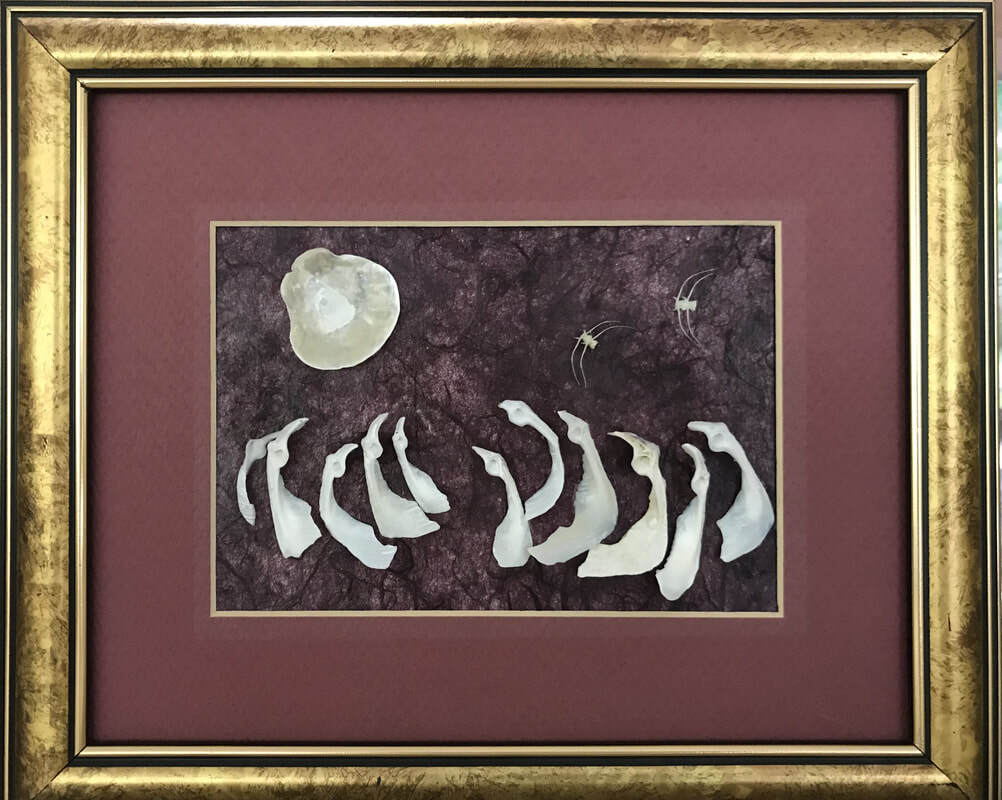
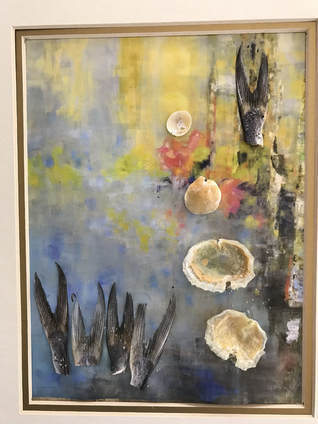
CALLING TO THE MOON
Handmade paper, jingle shell, broken clam shells, fish vertebrae bones.
10” x12” framed
We long to be one with the beauty of the moon; we are hungry for its wholeness, its light and beauty.
Handmade paper, jingle shell, broken clam shells, fish vertebrae bones.
10” x12” framed
We long to be one with the beauty of the moon; we are hungry for its wholeness, its light and beauty.
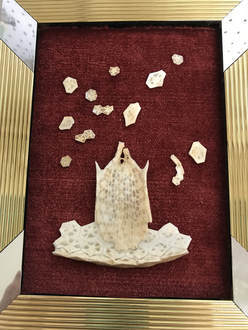
JEWEL IN THE LOTUS: SPREADING SEEDS
Cloth, bony exoskeleton of the honeycomb cowfish, paint.
6.75” x 8.5” framed
Embodying perfect form, sacred geometry, I sit in perfect repose, like the lotus on its peaceful leaf. I am rising from my open container, opening out, and spreading seeds for the future.
Cloth, bony exoskeleton of the honeycomb cowfish, paint.
6.75” x 8.5” framed
Embodying perfect form, sacred geometry, I sit in perfect repose, like the lotus on its peaceful leaf. I am rising from my open container, opening out, and spreading seeds for the future.
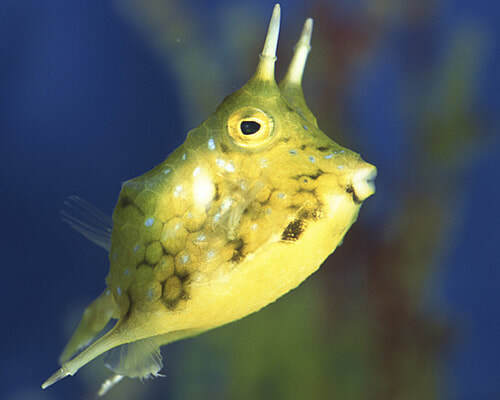
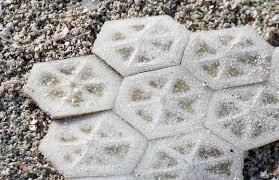
The honeycomb cowfish gets its name from the protruding “horns” over its eyes. Although the bodies I found were washed up on the shores of the Gulf, it is generally considered a reef fish, common in the Atlantic and Caribbean. What I find most fascinating is the way its body is encased in a “carapace,” an armor of hexagonal scale plates that cover everything but its cheeks or gills.
-------------------
WE RISE
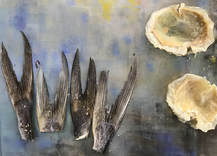
Ladyfish(?) tails, whelk egg case sections, jingle shell, printed paper.
10” x 12”
Longing, longing for what shines above. Moving toward, rising up.
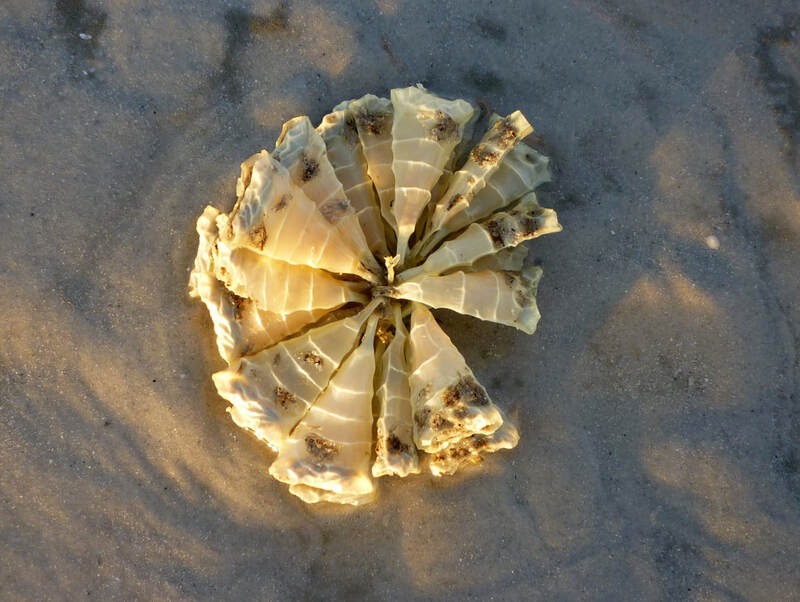
A mollusk’s egg casing is something quite astonishing. Whelks and conchs (see below) mate during spring and fall migrations, and the eggs are fertilized internally. The female surrounds them in a gel-like mass of albumin and lays them in a series of are joined-together protective “capsules.” A single capsule may contain as many as 100 eggs. The ones that whelks make form a long, snake-like chain–up to 150 capsules attached together. It’s a striking form that is sometimes known as a "Mermaid's Necklace." The mollusk attaches one end of the egg case onto a substrate in the sand, providing an anchor for the developing babies. When they have matured, they come out of the casing in their tiny (2-4mm) shells. Most, of course, do not make it. The egg cases themselves often get loose from their moorings and come ashore, but the whelks cannot survive out of the water.
www.youtube.com/watch?v=rJDdOD7IJzU
video showing knobbed whelk egg case up close.
www.youtube.com/watch?v=SZveJPKqFuU
video showing a lightening whelk laying eggs.
Ladyfish(?) tails, whelk egg case sections, jingle shell, printed paper.
10” x 12”
Longing, longing for what shines above. Moving toward, rising up.
A mollusk’s egg casing is something quite astonishing. Whelks and conchs (see below) mate during spring and fall migrations, and the eggs are fertilized internally. The female surrounds them in a gel-like mass of albumin and lays them in a series of are joined-together protective “capsules.” A single capsule may contain as many as 100 eggs. The ones that whelks make form a long, snake-like chain–up to 150 capsules attached together. It’s a striking form that is sometimes known as a "Mermaid's Necklace." The mollusk attaches one end of the egg case onto a substrate in the sand, providing an anchor for the developing babies. When they have matured, they come out of the casing in their tiny (2-4mm) shells. Most, of course, do not make it. The egg cases themselves often get loose from their moorings and come ashore, but the whelks cannot survive out of the water.
www.youtube.com/watch?v=rJDdOD7IJzU
video showing knobbed whelk egg case up close.
www.youtube.com/watch?v=SZveJPKqFuU
video showing a lightening whelk laying eggs.
------------------------------
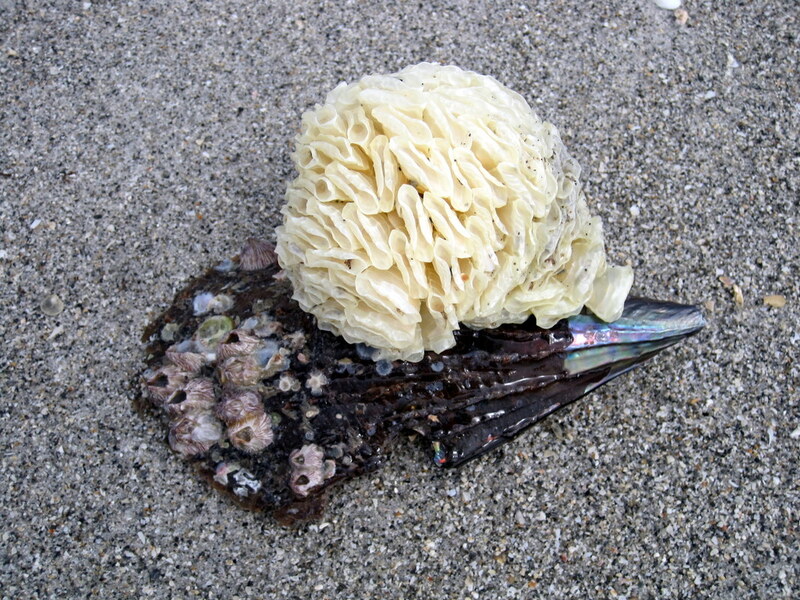
The last collage in the sample is more topical, starting as it did with the image of a struggling refugee, fleeing from political turmoil. This woman too became uplifted, however, so it is not just a tale of suffering. The woman is set against the luxury of Tudor-era velvet and surrounded by a golden aura. She reminds me of the Virgin of Guadalupe. Her spiky points of light are golden bits of Florida horse conch egg cases, which are in turn framed by 10 million year old fossilized pieces of sting ray spines and painted shell bits. It all comes together in a seemingly exploding form, love emanating from the anguish.
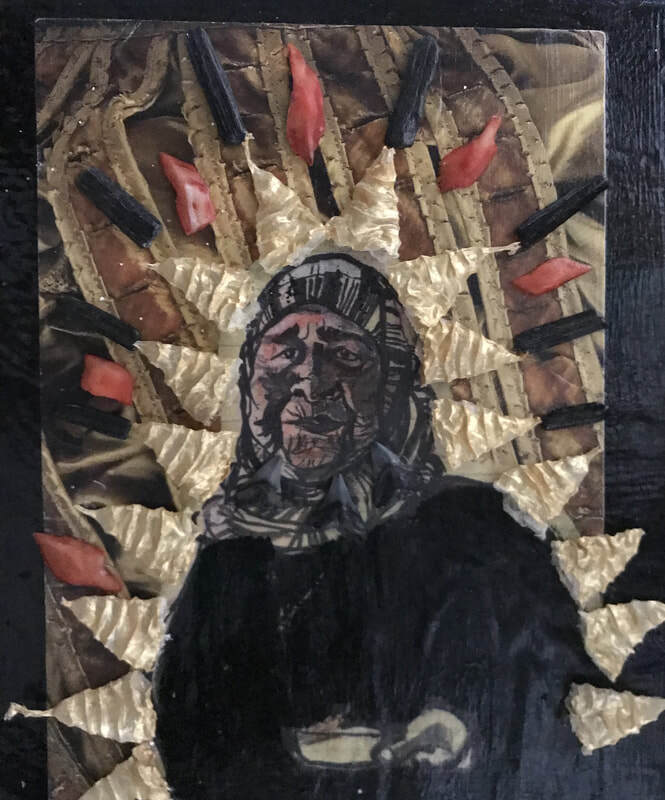
REFUGEE MADONNA
Printed paper, (painted) sections of Florida horse conch egg casing, fossilized sting ray spines, painted shell pieces.
5” x 7”
Through the pain of human suffering, she brings forth the aura of true compassion.
Printed paper, (painted) sections of Florida horse conch egg casing, fossilized sting ray spines, painted shell pieces.
5” x 7”
Through the pain of human suffering, she brings forth the aura of true compassion.
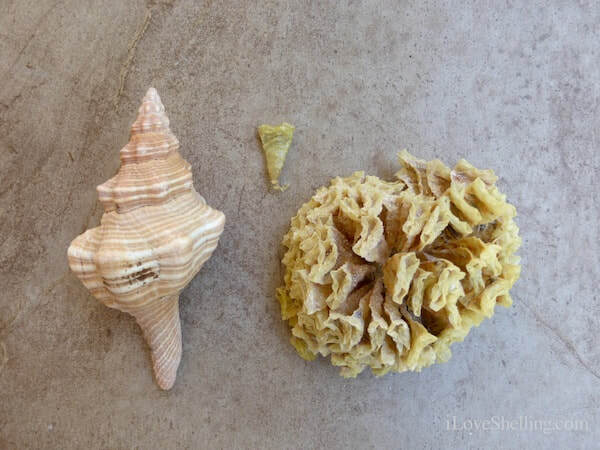
The Florida Horse Conch is closely related to the whelk. Her egg case is less linear. https://www.youtube.com/watch?v=fErY0AOfXsw
0 Comments