One of the most powerful things happening in the culture today is the rise of the deep feminine. We see it manifest in the #MeToo movement where women are standing up to not only speak their truth, but to insist on having it heard. But this rising energy goes far beyond women’s rights; it is about a new level of consciousness where the sacredness of all life and its concomitant values—compassion, inclusivity, the impetus to heal and make whole—are taking hold. The deep feminine is heart and spirit- (not logic) based, and it values creativity, imagination, and intuition. It sees earth as holy, as a living (mother) being. This is reflected in the growing awareness of ecological systems. The place I see it taken to its fullest expression is in the permaculture movement, whose advocates understand that it is the earth itself that holds the answers. Permaculturists are paying attention and learning to follow her wisdom.
The deep feminine is incompatible with most of the values that have governed our culture for so long—the patriarchal reality that has winners and losers and cultivates competition—ultimately, cultivates war—and values hierarchy and differential power. Even a cursory look at the world around us shows us that the old male paradigm is still ferociously trying to hold on. Nevertheless, the emerging energy is increasingly palpable and undeniable.
For quite a few years, I have been making collages that image this shift. (They have primarily come through in my SoulCollage® cards, and that is what I am documenting here.) I did not do this intentionally, but after several of the images began to speak to me, I realized I was seeing an actual theme, one which was showing up quite insistently. At first I was surprised and even confused by this, for I didn’t feel the issue of patriarchy was directly relevant to me. I had spent time uncovering it in the 1970s and speaking out for the women’s perspective in my academic work, but I was not feeling personally oppressed or needing to work through anything about the issue. But over time I came to understand the images were reflecting what was going on not so much in my own life, but in mass consciousness. The theme went far beyond patriarchy, moreover, and was about the more mythic and paradigmatic deep feminine. Once I saw what was emerging in the collages, I was fascinated to notice how the imagery and messages evolved over time, reflecting—or even presaging?—the evolving paradigmatic shift.
The deep feminine is incompatible with most of the values that have governed our culture for so long—the patriarchal reality that has winners and losers and cultivates competition—ultimately, cultivates war—and values hierarchy and differential power. Even a cursory look at the world around us shows us that the old male paradigm is still ferociously trying to hold on. Nevertheless, the emerging energy is increasingly palpable and undeniable.
For quite a few years, I have been making collages that image this shift. (They have primarily come through in my SoulCollage® cards, and that is what I am documenting here.) I did not do this intentionally, but after several of the images began to speak to me, I realized I was seeing an actual theme, one which was showing up quite insistently. At first I was surprised and even confused by this, for I didn’t feel the issue of patriarchy was directly relevant to me. I had spent time uncovering it in the 1970s and speaking out for the women’s perspective in my academic work, but I was not feeling personally oppressed or needing to work through anything about the issue. But over time I came to understand the images were reflecting what was going on not so much in my own life, but in mass consciousness. The theme went far beyond patriarchy, moreover, and was about the more mythic and paradigmatic deep feminine. Once I saw what was emerging in the collages, I was fascinated to notice how the imagery and messages evolved over time, reflecting—or even presaging?—the evolving paradigmatic shift.
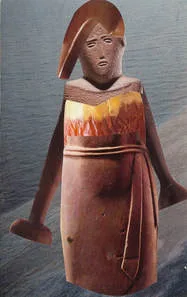
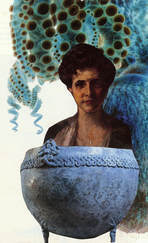
These images started to come through in 2011. THE WOMAN WHO MUST WATCH came first. She wasn’t expressly talking about male or female issues, but she was pretty powerless. She said,
I am a witness, without hands to fashion and create, without a strong voice. I must watch in silence. Fire may rise in my breast (my heart is alive) but it remains contained; I stand quiet and witness as the vast sea.
Someone else who saw her dubbed her “Our Lady of Perpetual Cleanup”—the one who has to clean up after everyone. I felt she stood for the housewife of the 1950s, the female ideal I grew up with.
I am a witness, without hands to fashion and create, without a strong voice. I must watch in silence. Fire may rise in my breast (my heart is alive) but it remains contained; I stand quiet and witness as the vast sea.
Someone else who saw her dubbed her “Our Lady of Perpetual Cleanup”—the one who has to clean up after everyone. I felt she stood for the housewife of the 1950s, the female ideal I grew up with.
About a month later, two other images came through that were very clear about male privilege.
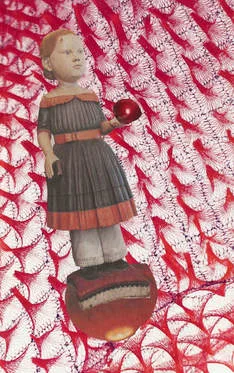
THE FATE OF WOMEN; VOICE OF THE PATRIARCHY had something of the same message as The Woman who Must Wait, but it was much more overt. The central figure carries Eve’s apple, representing a temptress or a kept-in-place scarlet woman, but she is actually a wooden figure, a stiff early American folk sculpture. The idea that she is a temptress seems ridiculous since she is only a child—an innocent—but she was still portrayed that way. She is, ironically, holding the “good book”—the Bible of Christian patriarchal culture. The red tufts in the background are part of a knitted textile, a type of fiber art. Since the 1960s, when the wave of consciousness-raising was at its peak, I have been conscious of fiber as a woman-identified and poorly respected art form. This detail thus also expresses the same idea of the devaluing of women. The collage said,
I am the one who carries the old woman’s place, constrained and taught young to keep silent, fear of the temptress. I live in the world of women’s work, fiber forms, encoded memory of being kept in line.
I am the one who carries the old woman’s place, constrained and taught young to keep silent, fear of the temptress. I live in the world of women’s work, fiber forms, encoded memory of being kept in line.
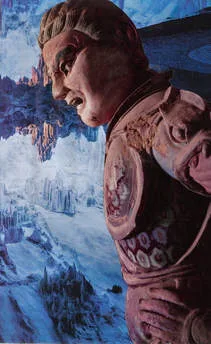
THE AUTHORITATIVE JUDGE appeared the same day. He said,
I am the one who screams at you and tells you that you did it wrong. My…heart is icy; I hold cold judgment. I am male judgment and superiority. You cannot find me because I live in an underground landscape, on an icy planet.
I am the one who screams at you and tells you that you did it wrong. My…heart is icy; I hold cold judgment. I am male judgment and superiority. You cannot find me because I live in an underground landscape, on an icy planet.
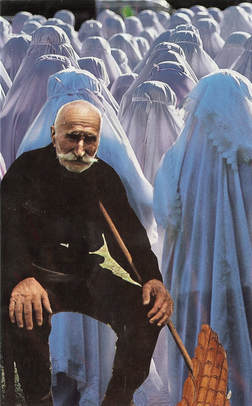
GRANDFATHER SHEPHERD came through a little later. I found this image both ambiguous and disturbing. The man literally reminded me of my grandfather and seemed to have a kind face, but his flock was puzzling. I wrote, “He is tending this flock of obedient, women, who we cannot see. They are sunlit, maybe praying, but always hidden. He guards them. He holds some wisdom, but he is tired, he has been doing this a long, long time.”
When I asked him to speak, he said,
I am grandfather, the old one, surviving a century, and I touch with the flippers of the mighty turtle. I hear echoes, and am curtained by generations of women, subservient, obedient, silent, who echo ritual through time, long echoing prayer and chanting. That is behind me, but I am not part of that, I look forward, touching into female power of the deep. I am a guardian at the edge and I gently nudge you on.
In hindsight, I see him as the first transition figure that came through. He was an old man—a male caught in his long-entrenched role, and he needed the women to bring forth more, something new.
When I asked him to speak, he said,
I am grandfather, the old one, surviving a century, and I touch with the flippers of the mighty turtle. I hear echoes, and am curtained by generations of women, subservient, obedient, silent, who echo ritual through time, long echoing prayer and chanting. That is behind me, but I am not part of that, I look forward, touching into female power of the deep. I am a guardian at the edge and I gently nudge you on.
In hindsight, I see him as the first transition figure that came through. He was an old man—a male caught in his long-entrenched role, and he needed the women to bring forth more, something new.
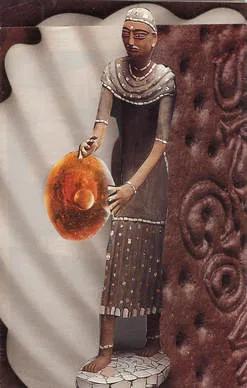
In 2012, there was more about the blending of male and female.
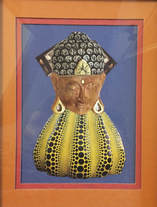
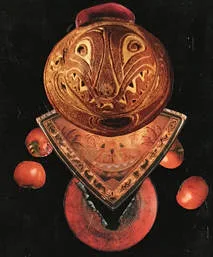
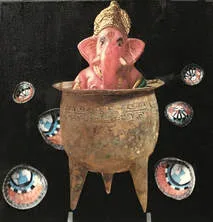
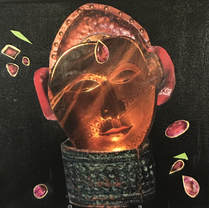
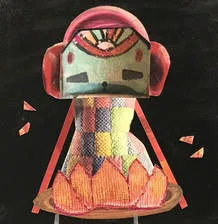
CHAND’S SWEET BEACON is an intriguing, almost amusing image, where the central figure is coming out of a pastry. Nek Chand was a self-taught artist whose community was devastated by the partition of India and Pakistan. He lived in Chandigarh, a city created out the remains of 26 villages on the Indian side of the border. In 1958, he secretly began creating figures for a sculpture garden in the forest buffer area between the two countries. He did this in secret, using waste materials such as broken glass, bangles, and crockery from the demolition sites. A 13 acre park eventually contained about 2,000 statues, one of which is included here.
I am one who emerges from the yin and yang of sweetness, I am a masculine-looking woman—a somewhat everyman/woman who was made by a man obsessed with creating a world of peace—in an ugly place, made beautiful. I am transformative power. I hold a glowing jewel, amber frozen resin perhaps, or glass, or sugar candy—but it pulsates and is breast-like, with a nipple, to feed. I am an earth mother of sorts, holding nurturance not from my body directly, but the awareness I bring. I have swirls and waves of sweetness. I have jewels, reconfigured bits sometimes. I hold out this nurturing, pulsating gift to you, glowing, glowing. It is my gift, reaching to you. It’s always here, a beacon, I am balanced, balancing, in perpetual offering.
I am one who emerges from the yin and yang of sweetness, I am a masculine-looking woman—a somewhat everyman/woman who was made by a man obsessed with creating a world of peace—in an ugly place, made beautiful. I am transformative power. I hold a glowing jewel, amber frozen resin perhaps, or glass, or sugar candy—but it pulsates and is breast-like, with a nipple, to feed. I am an earth mother of sorts, holding nurturance not from my body directly, but the awareness I bring. I have swirls and waves of sweetness. I have jewels, reconfigured bits sometimes. I hold out this nurturing, pulsating gift to you, glowing, glowing. It is my gift, reaching to you. It’s always here, a beacon, I am balanced, balancing, in perpetual offering.
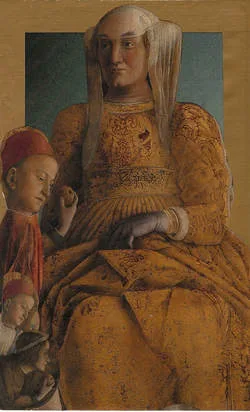
THE GENDERS SHIFT (RENAISSANCE HERMAPHRODITE) said:
I am the one who holds the shifting genders. I am the power figure, seeming male, but dressed now as a woman, fully clothed in veils and velvet, holding power in a crossed body, a new guise. The boys are the ones holding the apple now, or starting to, though there’s one who might be female too. We keep looking, staring not at each other, but at the hidden temptation. Flowing cloth, Renaissance splendor, turned around to an ambiguous moment, that turning of the tide, changing of the story, mystery of the golden apple.
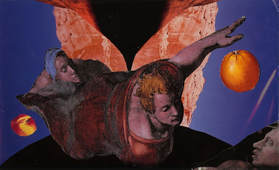
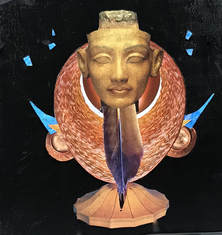
Renaissance imagery returned in 2014. It was used in SISTINE BIRTHING (OF THE GENTLE MALE)
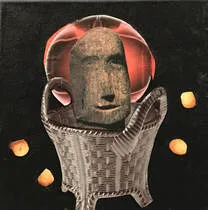
I am an odd creature, coming out of my chrysalis, still emerging into form—I come from the birth canal behind, which is full of mystery. I have multiple parts, maybe several bodies that will separate when we are no longer girdled. I reach for the energies floating around me, the nurturing orbs, though my eyes are still closed. Someone is watching me, perhaps another recently emerged or still emerging soul. I am masculine, taking form in a way recognizable to the male world, but I come from and am aligned with the female birthing place. I will be a gentler male force, as there is a glow from the female place and the glow from the orange orbs. I/we are wrapped in a light form, come here to this darker world. We have potential since we are lit with grace.
I am an odd creature, coming out of my chrysalis, still emerging into form—I come from the birth canal behind, which is full of mystery. I have multiple parts, maybe several bodies that will separate when we are no longer girdled. I reach for the energies floating around me, the nurturing orbs, though my eyes are still closed. Someone is watching me, perhaps another recently emerged or still emerging soul. I am masculine, taking form in a way recognizable to the male world, but I come from and am aligned with the female birthing place. I will be a gentler male force, as there is a glow from the female place and the glow from the orange orbs. I/we are wrapped in a light form, come here to this darker world. We have potential since we are lit with grace.
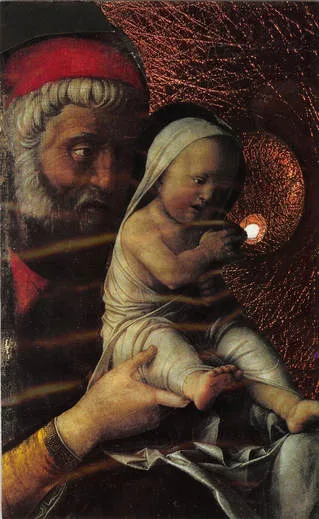
A Renaissance-era man was also featured in THROUGH THE GENERATIONS. He said,
I, the old one, hold the light of the future. I am a gentle male, fully birthed from the chrysalis of the Sistine Birthing, matured into a wise elder grandfather. I support the child, hold him gently and with reverence, as he/she contemplates the magic and the mystery and the beautiful world. I am well dressed and comfortable, well-fed, at ease, and the baby is as well, held in protective, loving cloth.
I remind you that we are all evolving, that you hold the future lovingly in your arms and support it as it—the children—discover their world. Teach them the magic and help them hold the glow. Boys as well as girls. I am grandfather, not managing the flock of shrouded women (Grandfather Shepherd), but with a new message about what is passed on. I am not a sufferer, and that is not the inheritance I leave; I am calm, stable, and reverent.
Please hold us with compassion and help us maintain the glow and female wisdom.
I remind you that we are all evolving, that you hold the future lovingly in your arms and support it as it—the children—discover their world. Teach them the magic and help them hold the glow. Boys as well as girls. I am grandfather, not managing the flock of shrouded women (Grandfather Shepherd), but with a new message about what is passed on. I am not a sufferer, and that is not the inheritance I leave; I am calm, stable, and reverent.
Please hold us with compassion and help us maintain the glow and female wisdom.
Renaissance-era figures even came through in some of the 2015 images. The Renaissance was apparently symbolizing the logical, “rational” element of the male paradigm—it was the “rebirth” of Western civilization, but it meant that much of the mystical, spiritual connection was lost.
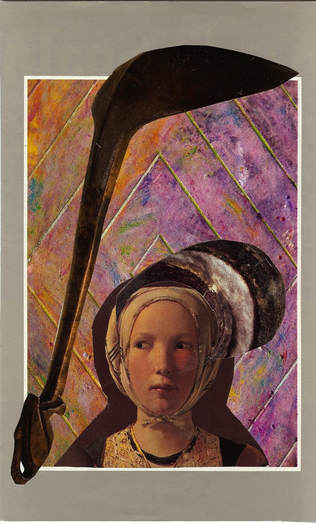
LOOKING TO THE LEFT stated,
I am a young woman (still a girl) of the past—the Renaissance era, the big bubble hat keeping me off balance to the right as the male world pulls me there. But I look to the left,… with some longing. Behind me, beautiful order, light-filled and satisfying. I am centered within that. Over my head a powerful form, a scythe of sorts, dark, like my shadow, threatening; or an umbrella, sheltering me; or a staff, upright and empowering, though still overwhelming…
I am well framed, in a story, and we can step out of this picture at any time; the club/scythe is already breaking those boundaries of the Western world and its tale.
I am a young woman (still a girl) of the past—the Renaissance era, the big bubble hat keeping me off balance to the right as the male world pulls me there. But I look to the left,… with some longing. Behind me, beautiful order, light-filled and satisfying. I am centered within that. Over my head a powerful form, a scythe of sorts, dark, like my shadow, threatening; or an umbrella, sheltering me; or a staff, upright and empowering, though still overwhelming…
I am well framed, in a story, and we can step out of this picture at any time; the club/scythe is already breaking those boundaries of the Western world and its tale.
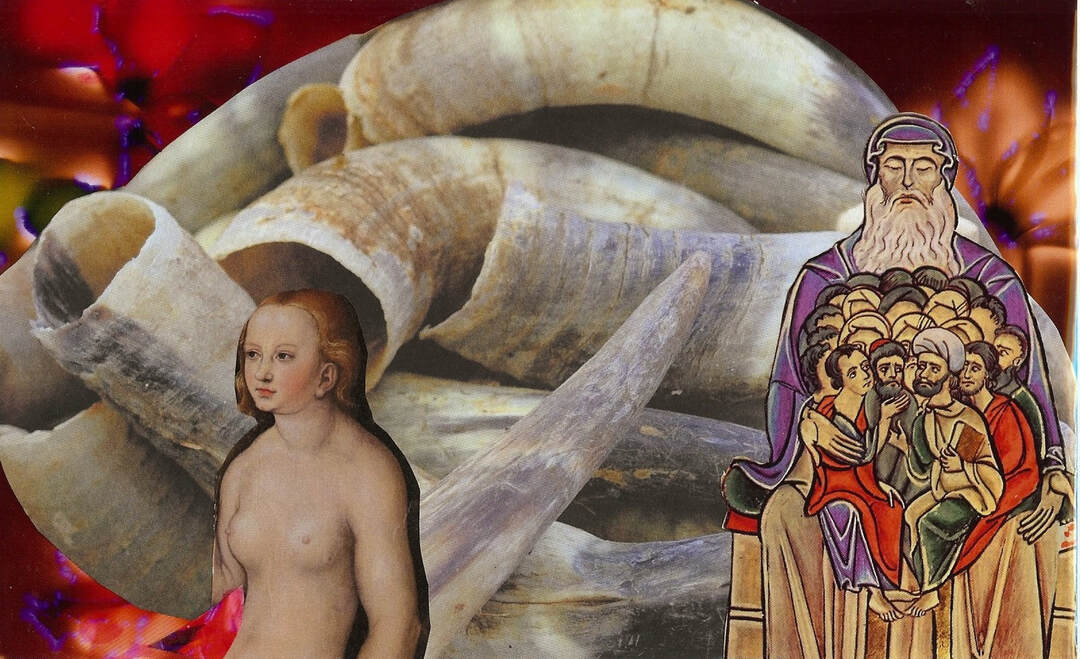
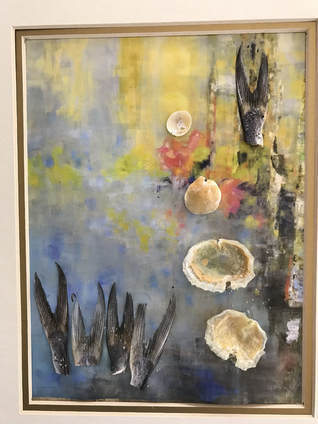
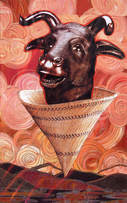
HERALD THE NEW ERA included a female figure exhibiting the classic “Gothic slouch,” again looking to the left. It also featured a group of huddled, seemingly frightened men. The card was made at the time of Rosh Hashanah, the Jewish New Year, when the ram’s horns (shofars) are ceremonially sounded.
The shofars are piled up, ready to be taken up and blown, heralding the new year, the new era, really moving into the 21st century and a new consciousness. There is a safe enclosing god-like figure holding those who are afraid, but it’s still a male, seemingly angry, clothed in the purple robes of state power. The people being contained are all men also. They are afraid, huddling together for protection. They can only see their own space and their own reality. Moving away from them, looking out to the left, is a woman, unafraid of the naked truth and going toward the newness the shofar is about to proclaim. Follow the feminine principle, with a different kind of togetherness and fearlessness. The light is glowing behind, this will be a time of a new consciousness. Join me, she says, she the new Eve.
The shofars are piled up, ready to be taken up and blown, heralding the new year, the new era, really moving into the 21st century and a new consciousness. There is a safe enclosing god-like figure holding those who are afraid, but it’s still a male, seemingly angry, clothed in the purple robes of state power. The people being contained are all men also. They are afraid, huddling together for protection. They can only see their own space and their own reality. Moving away from them, looking out to the left, is a woman, unafraid of the naked truth and going toward the newness the shofar is about to proclaim. Follow the feminine principle, with a different kind of togetherness and fearlessness. The light is glowing behind, this will be a time of a new consciousness. Join me, she says, she the new Eve.
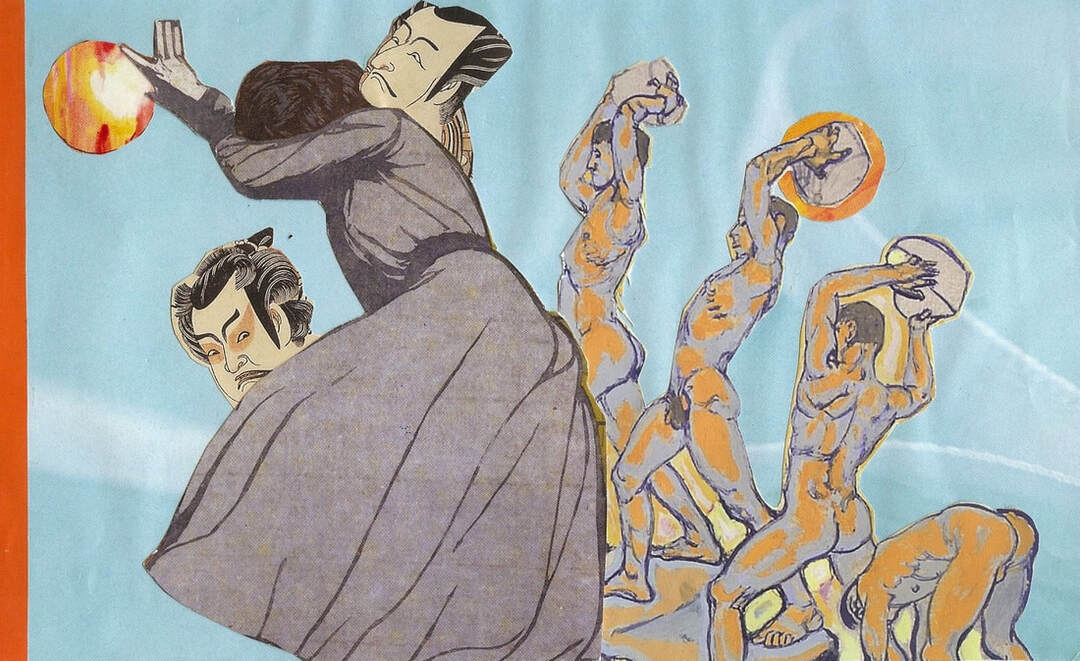
Another 2015 image, THE BURDEN OF MAN, drew on other mythology. It features characters from Kolomon Moser’s 1905 painting, The Fight of the Titans, which references the epic battle of the male gods from the mythology of ancient Greece. It also incorporates figures from the East – iconic Japanese faces are attached to a woman’s body. The collage told me,
I am one who carries the weight of the burden—white man’s burden, every man’s burden, carrying the rocks up the hill, Sisyphusian, struggling. There is light, and we, the men, are lit by the sun, but we look away, ready to hurl and attack. I hold the woman whose face is hidden, the angry male voices coming forth from her, and she too looks away, but in her hand is the sun-orb, the coming day. We must look toward it, lift our heads and calm these orange men. See how beautiful our forms are, our curves, our lines, our humanity. Woman, earth-voice, raise your face to the sun you carry, let that dream fall away, their voices fade out, dream a new dream of warmth, and follow the coming day.
I am one who carries the weight of the burden—white man’s burden, every man’s burden, carrying the rocks up the hill, Sisyphusian, struggling. There is light, and we, the men, are lit by the sun, but we look away, ready to hurl and attack. I hold the woman whose face is hidden, the angry male voices coming forth from her, and she too looks away, but in her hand is the sun-orb, the coming day. We must look toward it, lift our heads and calm these orange men. See how beautiful our forms are, our curves, our lines, our humanity. Woman, earth-voice, raise your face to the sun you carry, let that dream fall away, their voices fade out, dream a new dream of warmth, and follow the coming day.
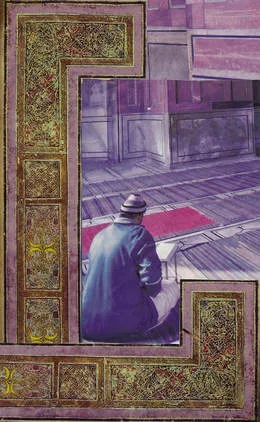
CONTEMPLATING THE FUTURE echoed the idea that men also want to transcend the male paradigm. It too went beyond the Western world, this time using imagery from Islam.
I am a lone man looking for the way out and through—looking to the future while still in the forms and spaces of the past. I am bookended and framed by all the devices and patterns of the old era, and I am trying to find god. My aloneness creates space but I need to join with others and move forward. There are openings here, and reminders of pathways and new perspectives. I can follow the light beams—the light path. The lavender is gentle, a sensibility not of machismo or the patriarchy, but a new middle way with feminized sensibility. The book I am reading is almost blank—just traces remain of the old and it’s time to stop reading the old or embroidering this old story and start moving down this path.
The theme of new futures showed up in a few other images in the next year or so, but they were less focused on the male and female paradigms. In 2017, however, the theme re-emerged, and the message was completely clear.
The theme of new futures showed up in a few other images in the next year or so, but they were less focused on the male and female paradigms. In 2017, however, the theme re-emerged, and the message was completely clear.
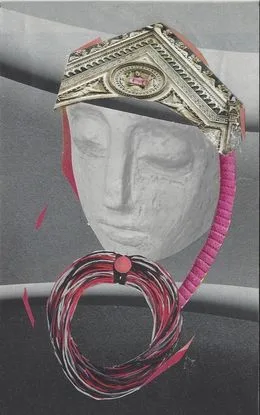
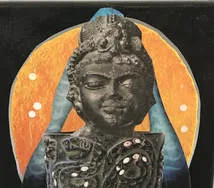
EMERGING PARADIGM was made after the Woman’s March with the “pussy hats” protesting Trump’s presidential inauguration, so the pink was a very clear reference to women coming together.
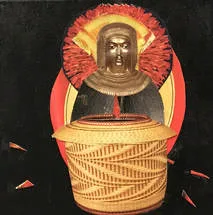
I have a face and an energy from the old reality, a bit sad or melancholy, caught as I am in the frozen stone of where women have been held. In my old form I do not have great color. But see my pink: pink arising—this feminine power still emerging. Note the communication cord, moving to the new unfurling, the new necklace. There is pink emerging even in the cornice, coming out from behind, and centering on the third eye. And there are angels there too, flanking that space. They hold this process in love. The necklace at the throat, the new open-centered (open-hearted) circle of the coming collective consciousness is the voice of what comes. The black and white is pinked—no longer opposites. These are weaver’s threads, cables, and cords. It’s all flexible medium, soft, coiled and expandable, expansive. It is/it will be round, open-ended, not fixed in place.
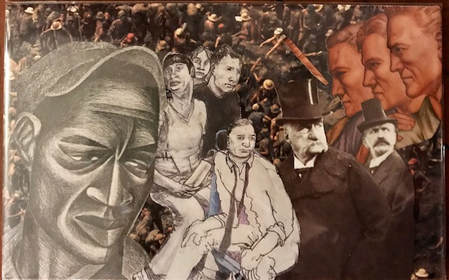
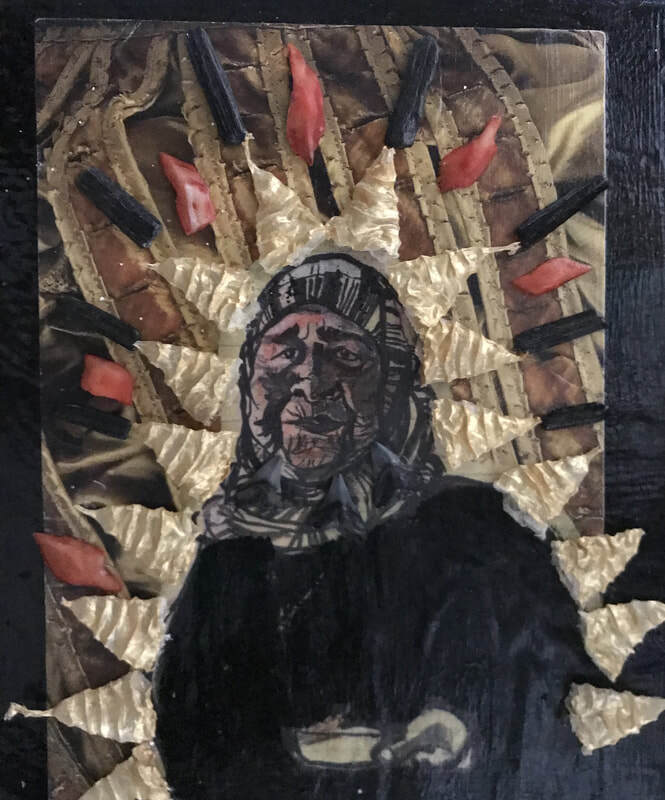
The last image I offer here was made in the spring of 2018. THE PAIN OF MEN goes even further with the idea that men are also oppressed by the old paradigm.
The background in this image is a vast crowd of protesting miners. There are also the minorities suffering the pain of abuse, the capitalists who exploit, and the men who are beginning to wake up to the pain of what has been going on, (an image from current news of the men being called to task for patriarchal abuse). The new men—in color—are looking on, the only ones looking to the left. They are not yet happy, but there is a hand on the heart; they are in transition. They know that the power-mongers always act that way because of their inner pain.
The image spoke:
I am another marker on the way, holding the pain. It is still there, but now beginning to be seen. Watch: we can emerge to the alternate universe. Send us love, we wish to emerge, and know it is a heavy, heavy burden for us too.
The background in this image is a vast crowd of protesting miners. There are also the minorities suffering the pain of abuse, the capitalists who exploit, and the men who are beginning to wake up to the pain of what has been going on, (an image from current news of the men being called to task for patriarchal abuse). The new men—in color—are looking on, the only ones looking to the left. They are not yet happy, but there is a hand on the heart; they are in transition. They know that the power-mongers always act that way because of their inner pain.
The image spoke:
I am another marker on the way, holding the pain. It is still there, but now beginning to be seen. Watch: we can emerge to the alternate universe. Send us love, we wish to emerge, and know it is a heavy, heavy burden for us too.